
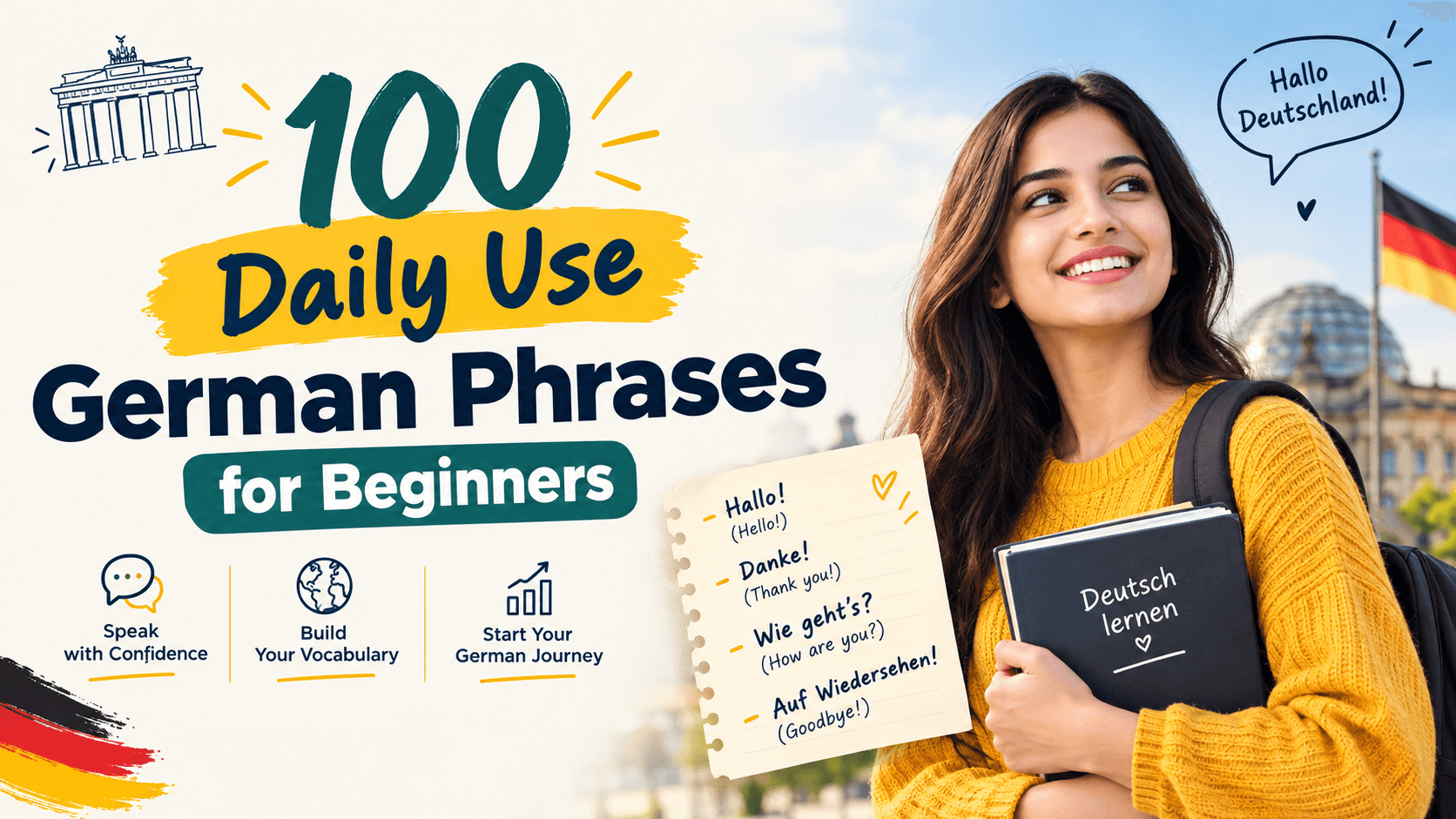
100 Daily Use German Phrases for Beginners
Doitsu · 20 November 2026
Starting German can feel like climbing a wall of grammar tables. The good news is that you do not need perfect grammar to speak. You need a small set of German phrases for beginners that you can use again and again. This guide gives you 100 daily use German phrases with clear English meanings, grouped by situation, so you can say the right thing at the right time.
Whether you are preparing for the A1 exam, planning a trip, or dreaming of an Ausbildung in Germany, these basic German phrases are your first toolkit. Every phrase below is short, natural and used by native speakers every day.
Explore our German language courses to find the right programme for you.
Why Learn Common German Phrases First?
Memorising single words is slow. Phrases give you ready-made sentences, correct word order included. That is why the common German phrases below work better for German conversation for beginners than a long vocabulary list.
-
You speak sooner. One phrase equals one complete thought.
-
You learn grammar by accident. Seeing "Ich möchte einen Kaffee" teaches you word order without a rulebook.
-
You gain confidence. Real conversations start with greetings, questions and polite replies.
-
You prepare for exams. The Goethe A1 speaking section tests exactly these everyday situations.
How to Use These Everyday German Phrases
Two quick rules will save you from awkward moments:
-
Sie vs. du. Sie is formal (strangers, officials, shop staff). du is informal (friends, classmates, family). When unsure, use Sie.
-
Learn the sentence, not the word. Say the full German line aloud, then the English meaning, then the German again.
Quick Pronunciation Tips
-
ch after a, o, u sounds like a soft throat sound (Buch); after i or e it is lighter (ich).
-
w sounds like English "v" (Wasser). v often sounds like "f" (Vater).
-
z sounds like "ts" (Zeit). sch sounds like "sh" (Schule).
-
ä, ö, ü are separate vowels. ß is a sharp double "s".
Explore our German language course admission details.
Basic German Phrases: Greetings and Introductions
Greetings open every conversation. Master these German greetings and introductions first, and you can already introduce yourself in German.
Greetings (1–10)
|
# |
German |
English Meaning |
|
1 |
Hallo |
Hello |
|
2 |
Guten Morgen |
Good morning |
|
3 |
Guten Tag |
Good day / Hello |
|
4 |
Guten Abend |
Good evening |
|
5 |
Gute Nacht |
Good night |
|
6 |
Tschüss |
Bye |
|
7 |
Auf Wiedersehen |
Goodbye (formal) |
|
8 |
Bis später |
See you later |
|
9 |
Bis morgen |
See you tomorrow |
|
10 |
Herzlich willkommen |
Welcome |
How to Introduce Yourself in German (11–20)
|
# |
German |
English Meaning |
|
11 |
Ich heiße Priya |
My name is Priya |
|
12 |
Wie heißen Sie? |
What is your name? (formal) |
|
13 |
Wie heißt du? |
What is your name? (informal) |
|
14 |
Freut mich |
Nice to meet you |
|
15 |
Ich komme aus Indien |
I come from India |
|
16 |
Woher kommen Sie? |
Where are you from? |
|
17 |
Ich wohne in Delhi |
I live in Delhi |
|
18 |
Ich bin Student / Studentin |
I am a student (male / female) |
|
19 |
Ich bin zwanzig Jahre alt |
I am twenty years old |
|
20 |
Ich lerne Deutsch |
I am learning German |
Daily Use German Sentences: Politeness and Understanding
These daily use German sentences keep conversations smooth. Politeness matters in Germany, and a simple bitte or danke goes a long way. The second group helps when you get lost in a conversation, which happens to every beginner.
Polite Expressions (21–30)
|
# |
German |
English Meaning |
|
21 |
Bitte |
Please / You're welcome |
|
22 |
Danke |
Thanks |
|
23 |
Vielen Dank |
Thank you very much |
|
24 |
Gern geschehen |
You're welcome |
|
25 |
Entschuldigung |
Excuse me / Sorry |
|
26 |
Es tut mir leid |
I am sorry |
|
27 |
Kein Problem |
No problem |
|
28 |
Alles gut |
All good |
|
29 |
Ja, gerne |
Yes, gladly |
|
30 |
Nein, danke |
No, thank you |
Basic German Questions and Answers (31–40)
|
# |
German |
English Meaning |
|
31 |
Wie geht es Ihnen? |
How are you? (formal) |
|
32 |
Wie geht's? |
How's it going? |
|
33 |
Mir geht es gut, danke |
I am fine, thanks |
|
34 |
Sprechen Sie Englisch? |
Do you speak English? |
|
35 |
Ich spreche ein bisschen Deutsch |
I speak a little German |
|
36 |
Ich verstehe nicht |
I don't understand |
|
37 |
Können Sie das wiederholen? |
Can you repeat that? |
|
38 |
Langsamer, bitte |
Slower, please |
|
39 |
Was bedeutet das? |
What does that mean? |
|
40 |
Wie sagt man das auf Deutsch? |
How do you say that in German? |
German Phrases with English Meaning for Travel, Food and Shopping
Now for German phrases for shopping and travelling. These are the sentences you will use the moment you step outside, whether in Berlin or at a German-themed café at home.
Learn more about the German A1 exam in Delhi.
Directions and Travel (41–50)
|
# |
German |
English Meaning |
|
41 |
Wo ist der Bahnhof? |
Where is the station? |
|
42 |
Wo ist die Toilette? |
Where is the toilet? |
|
43 |
Geradeaus, dann links |
Straight ahead, then left |
|
44 |
Ist es weit von hier? |
Is it far from here? |
|
45 |
Eine Fahrkarte nach Berlin, bitte |
One ticket to Berlin, please |
|
46 |
Wann fährt der Zug? |
When does the train leave? |
|
47 |
Welcher Bus fährt zum Flughafen? |
Which bus goes to the airport? |
|
48 |
Ich suche das Hotel |
I am looking for the hotel |
|
49 |
Ich habe eine Reservierung |
I have a reservation |
|
50 |
Können Sie mir helfen? |
Can you help me? |
Food and Restaurant (51–60)
|
# |
German |
English Meaning |
|
51 |
Ich möchte einen Kaffee |
I would like a coffee |
|
52 |
Die Speisekarte, bitte |
The menu, please |
|
53 |
Was empfehlen Sie? |
What do you recommend? |
|
54 |
Ich bin Vegetarier |
I am vegetarian |
|
55 |
Ein Glas Wasser, bitte |
A glass of water, please |
|
56 |
Guten Appetit! |
Enjoy your meal! |
|
57 |
Das schmeckt gut |
This tastes good |
|
58 |
Die Rechnung, bitte |
The bill, please |
|
59 |
Zusammen oder getrennt? |
Together or separate? |
|
60 |
Stimmt so |
Keep the change |
Shopping (61–70)
|
# |
German |
English Meaning |
|
61 |
Was kostet das? |
How much does this cost? |
|
62 |
Das ist zu teuer |
That is too expensive |
|
63 |
Haben Sie das in Größe M? |
Do you have this in size M? |
|
64 |
Ich nehme das |
I'll take this |
|
65 |
Kann ich mit Karte bezahlen? |
Can I pay by card? |
|
66 |
Ich schaue nur |
I'm just looking |
|
67 |
Gibt es einen Rabatt? |
Is there a discount? |
|
68 |
Wo ist die Kasse? |
Where is the checkout? |
|
69 |
Haben Sie eine Tüte? |
Do you have a bag? |
|
70 |
Ich brauche eine Quittung |
I need a receipt |
Everyday German Expressions for Home, Health and Emergencies
These German expressions used in daily life cover routines, feelings and the moments when you need help fast. Learn the emergency group even if you hope never to use it.
Explore our German language classes in Laxmi Nagar.
Daily Routine and Time (71–80)
|
# |
German |
English Meaning |
|
71 |
Wie spät ist es? |
What time is it? |
|
72 |
Es ist halb drei |
It is 2:30 (literally "half three") |
|
73 |
Wie ist das Wetter heute? |
How is the weather today? |
|
74 |
Heute ist es heiß |
It is hot today |
|
75 |
Ich stehe um sechs Uhr auf |
I get up at six o'clock |
|
76 |
Ich gehe zur Arbeit |
I am going to work |
|
77 |
Ich bin müde |
I am tired |
|
78 |
Ich habe Hunger |
I am hungry |
|
79 |
Ich habe Durst |
I am thirsty |
|
80 |
Was machst du heute? |
What are you doing today? |
Health and Emergencies (81–90)
|
# |
German |
English Meaning |
|
81 |
Hilfe! |
Help! |
|
82 |
Ich brauche einen Arzt |
I need a doctor |
|
83 |
Ich fühle mich nicht gut |
I don't feel well |
|
84 |
Ich habe Kopfschmerzen |
I have a headache |
|
85 |
Rufen Sie einen Krankenwagen! |
Call an ambulance! |
|
86 |
Rufen Sie die Polizei! |
Call the police! |
|
87 |
Wo ist die Apotheke? |
Where is the pharmacy? |
|
88 |
Ich habe meinen Pass verloren |
I have lost my passport |
|
89 |
Es ist ein Notfall |
It is an emergency |
|
90 |
Ich bin allergisch gegen Nüsse |
I am allergic to nuts |
German Conversation for Beginners: Small Talk and Good Wishes
Small talk is where basic German conversation sentences come alive. These last ten phrases help you keep a chat going and celebrate with people.
Explore our German language course for Ausbildung in Delhi.
Small Talk and Wishes (91–100)
|
# |
German |
English Meaning |
|
91 |
Was machst du gern in deiner Freizeit? |
What do you like to do in your free time? |
|
92 |
Ich mag Musik |
I like music |
|
93 |
Das ist toll! |
That's great! |
|
94 |
Wirklich? |
Really? |
|
95 |
Ich weiß nicht |
I don't know |
|
96 |
Viel Glück! |
Good luck! |
|
97 |
Herzlichen Glückwunsch! |
Congratulations! |
|
98 |
Alles Gute zum Geburtstag! |
Happy birthday! |
|
99 |
Gute Reise! |
Have a good trip! |
|
100 |
Bis bald! |
See you soon! |
Mini Dialogue: Meeting Someone New
Put the phrases together in a short German conversation for beginners:
A: Guten Tag! Ich heiße Priya. Wie heißen Sie?
B: Guten Tag, Priya. Ich heiße Max. Freut mich!
A: Freut mich auch. Ich komme aus Indien. Woher kommen Sie?
B: Ich komme aus München. Sprechen Sie Deutsch?
A: Ich spreche ein bisschen Deutsch. Langsamer, bitte.
B: Kein Problem! Bis bald!
Prepare for the Goethe exam in Delhi with expert guidance.
German Speaking Practice for Beginners at Home
Reading phrases is not enough. Use this simple routine for easy German speaking practice at home:
-
Pick 5 phrases a day. Twenty days covers all 100.
-
Say each one aloud three times. Record yourself and compare with a native audio source.
-
Swap the details. Change "Ich komme aus Indien" to your own city or job.
-
Role-play. Act out the mini dialogue above with a friend, or alone in front of a mirror.
-
Review daily. Revisit yesterday's phrases before learning new ones.
Self-study works, but a teacher corrects pronunciation and word order before mistakes become habits. If you want guided practice, a structured class makes progress faster.
Learn German with Doitsu – The German Language Institute
At Doitsu – The German Language Institute in Laxmi Nagar, Delhi, we teach German step by step, from your first greeting to advanced fluency. Our courses run across every CEFR level:
-
German A1 Course – start from zero with these exact everyday phrases.
-
German A2 Course – build longer sentences and real conversations.
-
German B1 Course – speak and write with growing independence.
-
Explore all German courses, including B2, C1, C2 and the Ausbildung course.
Wondering how we compare? Read why students choose Doitsu or learn more about us.
Useful reading before you enrol:
Ready to start speaking German? Apply for admission or book a free counselling call today.
Frequently Asked Questions (FAQs)
What are the most common German phrases?
The most common German phrases are Hallo, Guten Morgen, Danke, Bitte, Entschuldigung, Wie geht's?, Ich verstehe nicht and Sprechen Sie Englisch? You will use these in almost every interaction.
How do beginners start speaking German?
Start with greetings, introductions and polite phrases. Practise five phrases daily, say them aloud, and use them in short dialogues. Joining a beginner class gives you a partner to practise with and a teacher to correct you.
What are some basic German sentences?
Examples include Ich heiße… (My name is…), Ich komme aus… (I come from…), Ich lerne Deutsch (I am learning German) and Was kostet das? (How much does it cost?). All appear in the list above.
How do you greet someone in German?
Use Guten Morgen in the morning, Guten Tag during the day and Guten Abend in the evening. Among friends, Hallo works anytime. To say goodbye, use Tschüss (casual) or Auf Wiedersehen (formal).
How can I learn everyday German conversations?
Learn phrases in situations (café, station, shop), practise with a partner, and listen to slow native audio. Use full sentences instead of single words, and repeat them aloud until they feel natural.
What German phrases should beginners learn first?
Begin with greetings, introductions, bitte and danke, and the "I don't understand" group: Ich verstehe nicht, Langsamer, bitte and Können Sie das wiederholen? These keep conversations alive when you feel lost.
How do you introduce yourself in German?
Say Hallo, ich heiße [name]. Ich komme aus [country]. Ich wohne in [city]. Ich lerne Deutsch. Add Freut mich when you meet the other person.
How can I improve my German speaking skills?
Speak daily, even to yourself. Record your voice, shadow native speakers, learn phrases rather than isolated words, and take speaking-focused classes. Regular correction from a trainer improves German communication skills faster than studying alone.
Final Thoughts
These 100 daily use German phrases give you a strong base for greetings, travel, shopping, health and small talk. Practise a few every day, and within a month you will handle simple German conversations with confidence. When you are ready for structured guidance, Doitsu is here to help you go from A1 to fluency.
Contact Doitsu – The German Language Institute
Call Us +91 76783 94825
Email info@doitsugermanlanguageinstitute.com
Visit Us 3rd Floor, 2/81, Lalita Park, Laxmi Nagar, New Delhi, Delhi, 110092