
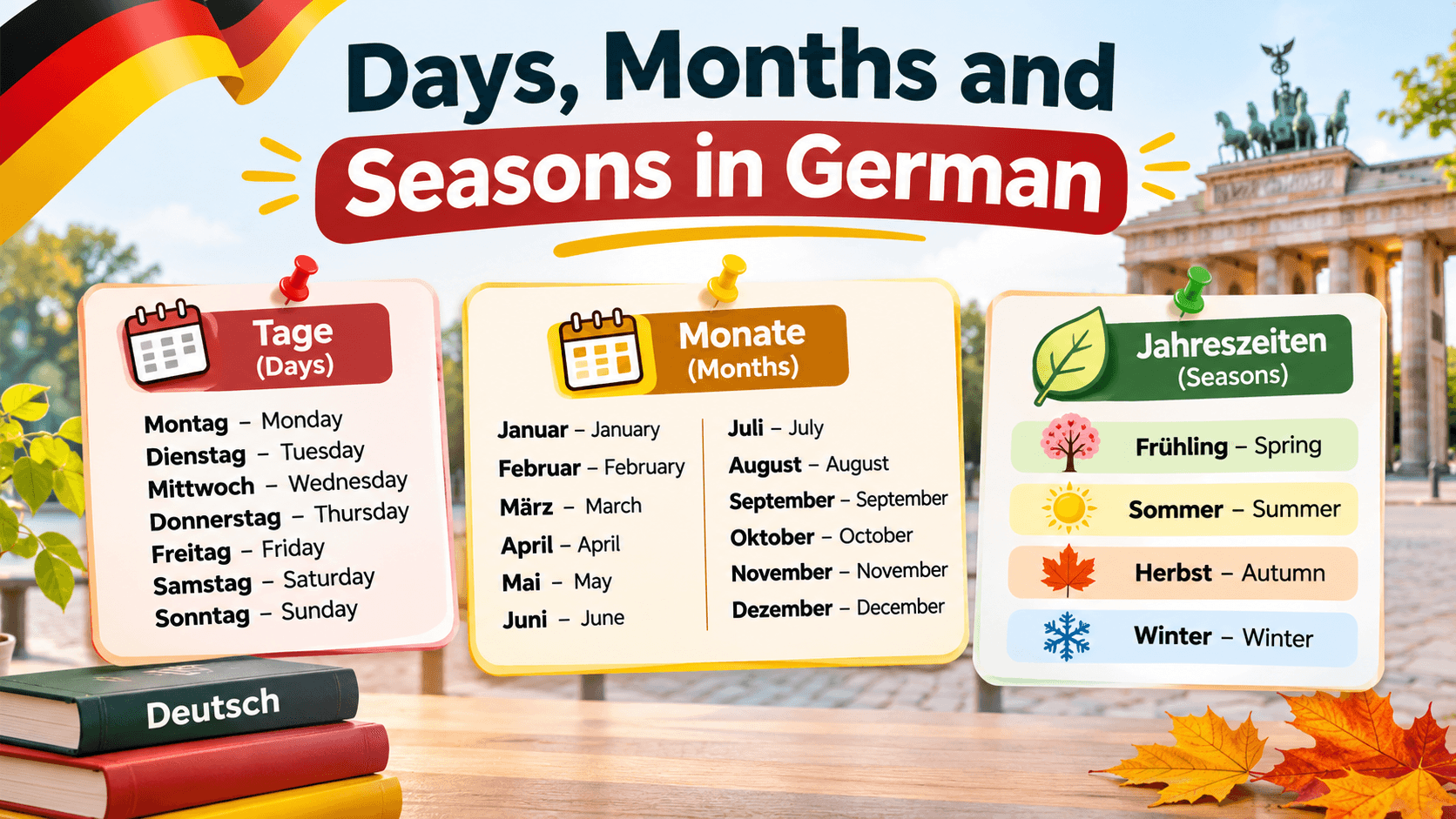
Days, Months and Seasons in German
Doitsu · 21 November 2026
Every German conversation eventually touches time. You book an appointment, ask when a class starts, mention a birthday or plan a trip, and suddenly you need the days of the week in German, the months in German and the seasons in German. These words are small, but they unlock a huge part of daily communication.
The good news? This is one of the friendliest topics in German vocabulary for beginners. Many words look similar to English, the grammar is predictable, and once you learn two tiny rules, you can talk about any date with confidence.
In this guide from Doitsu – The German Language Institute, you will find every word with its English translation and pronunciation, memory tricks, example sentences, a practice plan and a full FAQ section. Whether you are preparing for the A1 Goethe exam, planning to study in Germany, or just starting your German language basics, bookmark this page.
Learn the basics of German articles der, die and das with simple explanations.
Days of the Week in German
The German word for "day" is Tag and for "week" is Woche. The seven days are called die Wochentage (weekdays plus weekend). Here are the German weekdays with English meaning and a simple pronunciation guide.
|
# |
German |
Pronunciation |
English |
|
1 |
der Montag |
MOHN-tahk |
Monday |
|
2 |
der Dienstag |
DEENS-tahk |
Tuesday |
|
3 |
der Mittwoch |
MIT-vokh |
Wednesday |
|
4 |
der Donnerstag |
DON-ers-tahk |
Thursday |
|
5 |
der Freitag |
FRY-tahk |
Friday |
|
6 |
der Samstag (also Sonnabend) |
ZAHMS-tahk |
Saturday |
|
7 |
der Sonntag |
ZON-tahk |
Sunday |
Monday to Sunday in German follows the same order as in India and most of the world, and German calendars place Monday in the first column. The weekend is das Wochenende, and a working day is der Werktag.
Quick tip: Every day of the week is masculine, so you always say der. One article to remember, seven words learned.
What the Day Names Actually Mean
German day names are more interesting than they look, and knowing the story makes them stick:
-
Montag is the "day of the moon" (der Mond means moon).
-
Dienstag is linked to an old Germanic god of law and war.
-
Mittwoch literally means "mid-week" (Mitte + Woche).
-
Donnerstag is the "day of thunder" (der Donner means thunder).
-
Freitag honours a Germanic goddess, just like English Friday.
-
Samstag traces back to the word Sabbath. In northern and eastern Germany you may also hear Sonnabend, meaning "Sunday eve".
-
Sonntag is the "day of the sun" (die Sonne means sun).
Start learning 100 daily-use German phrases for beginners to improve everyday communication.
Months in German (January to December)
Now for the months in German. Here is the full list from January to December in German, along with German month names with pronunciation.
|
# |
German |
Pronunciation |
English |
|
1 |
der Januar |
YAH-noo-ar |
January |
|
2 |
der Februar |
FAY-broo-ar |
February |
|
3 |
der März |
mehrts |
March |
|
4 |
der April |
ah-PRIL |
April |
|
5 |
der Mai |
my |
May |
|
6 |
der Juni |
YOO-nee |
June |
|
7 |
der Juli |
YOO-lee |
July |
|
8 |
der August |
ow-GOOST |
August |
|
9 |
der September |
zep-TEM-ber |
September |
|
10 |
der Oktober |
ok-TOH-ber |
October |
|
11 |
der November |
no-VEM-ber |
November |
|
12 |
der Dezember |
day-TSEM-ber |
December |
The 12 months called in German are all masculine, just like the days. Ten of them look almost identical to English. Only März (March) and Dezember (December) need extra attention because of the umlaut and the "z" sound.
Interesting Month Facts
-
Austria often uses Jänner instead of Januar.
-
On a bad phone line, Juni and Juli sound alike, so many Germans say Juno and Julei to avoid confusion.
-
The German word for month is der Monat, and the plural is die Monate.
-
The word for year is das Jahr and for calendar is der Kalender.
Students can explore German A1 exam preparation in Delhi before appearing for the test.
Seasons in German
Germany has four clear seasons, and so does North India, which makes this vocabulary easy to connect with real life. The four seasons in German are called die Jahreszeiten (literally "year times").
|
German |
Pronunciation |
English |
|
der Frühling |
FROO-ling |
Spring |
|
der Sommer |
ZOM-er |
Summer |
|
der Herbst |
hairpst |
Autumn / Fall |
|
der Winter |
VIN-ter |
Winter |
All four are masculine again. You may also see das Frühjahr, a slightly more formal word for spring.
Think of Delhi's weather: Sommer is the long, hot season, the Herbst brings a pleasant change in October and November, Winter is foggy and cold, and Frühling is the short, lovely stretch in February and March. Linking each season to something you personally experience is a very effective way to practise German seasons vocabulary for beginners.
Example sentences:
-
Im Sommer ist es in Delhi sehr heiß. (In summer it is very hot in Delhi.)
-
Mein Lieblingsmonat ist der Oktober. (My favourite month is October.)
-
Im Winter trinke ich gern Tee. (In winter I like to drink tea.)
How to Pronounce German Days, Months and Seasons
German pronunciation for beginners is more consistent than English. Once you know a handful of sound rules, you can read almost any word out loud.
-
W sounds like V. That is why Mittwoch is "MIT-vokh" and Winter is "VIN-ter".
-
S before a vowel sounds like Z. So Sonntag, Samstag, Sommer and September all start with a "z" sound.
-
J sounds like Y. Januar, Juni and Juli all begin with "Y".
-
Final -g sounds like K in -tag words. Montag ends in "tahk", not "tag".
-
Ei sounds like "eye". Freitag is "FRY-tahk" and Mai is "my".
-
Ä sounds like the "e" in "bed". Say März with an open mouth.
-
Ü needs rounded lips. Say "ee" while pushing your lips forward, and you get the sound in Frühling.
-
Z sounds like "ts". Dezember is "day-TSEM-ber".
Stress pattern: All seven days put the stress on the first syllable. Months like April, August, September, Oktober, November and Dezember are stressed on the second syllable.
Practise by saying each list aloud every morning for a week. The German weekday pronunciation becomes automatic much faster than most learners expect.
Check the Goethe exam dates for November 2026 in India to plan your German certification.
The Two Golden Rules: am and im
Here is the grammar secret that makes German time and date vocabulary easy. German uses two small words before time expressions:
|
Use |
With |
Example |
Meaning |
|
am |
Days and parts of the day |
am Montag, am Wochenende, am Abend |
on Monday, on the weekend, in the evening |
|
im |
Months and seasons |
im Mai, im Dezember, im Sommer |
in May, in December, in summer |
Both words are short forms: am = an dem and im = in dem. They work because every day, month and season is a masculine noun.
More examples:
-
Ich habe am Dienstag Unterricht. (I have class on Tuesday.)
-
Mein Geburtstag ist im Oktober. (My birthday is in October.)
-
Am Sonntag besuche ich meine Familie. (On Sunday I visit my family.)
-
Im Frühling fahre ich nach Berlin. (In spring I travel to Berlin.)
For clock time, use um: um 9 Uhr (at 9 o'clock). So the trio is um for time, am for days, im for months. If you want to see how articles such as der, die, das really work, read our simple guide on German articles: der, die, das made simple.
Capital Letters and Abbreviations
Days, months and seasons are nouns, so they always start with a capital letter in German, even in the middle of a sentence. Calendars use short forms without a full stop:
Mo, Di, Mi, Do, Fr, Sa, So
Add an -s to make a habit word: montags (on Mondays, every Monday) and freitags (on Fridays). These "habit" words are written in lowercase.
How to Say Dates in German
Learning how to say dates in German is easier than you think. Germans write the date in day.month.year order, using dots:
21.11.2026
To say a date aloud, you use an ordinal number (first, second, third) followed by the month.
-
Der 21. November is spoken as der einundzwanzigste November.
-
With am, the ordinal ends in -n: am einundzwanzigsten November (on the 21st of November).
Ordinal number basics:
-
1st = erste, 3rd = dritte, 7th = siebte (irregular)
-
2nd to 19th usually end in -te: zweite, vierte, zehnte
-
20th onwards end in -ste: zwanzigste, dreißigste
Useful date questions:
-
Welcher Tag ist heute? (What day is it today?)
-
Der Wievielte ist heute? (What is today's date?)
-
Wann hast du Geburtstag? (When is your birthday?)
Sample answers:
-
Heute ist Samstag, der 21. November. (Today is Saturday, 21 November.)
-
Ich habe am 15. August Geburtstag. (My birthday is on 15 August.)
-
Die Prüfung ist im November. (The exam is in November.)
Ready to level up? Here is a deeper look at German A1 exam preparation in Delhi, where date questions regularly appear in the speaking and writing sections. If you are planning your exam, also check the Goethe exam dates for November 2026 in India.
Easy Ways to Remember German Calendar Vocabulary
Wondering how to remember German month names and weekdays without feeling overwhelmed? Try these proven methods that our trainers at Doitsu recommend.
-
Use English links. Montag = Moon day, Sonntag = Sun day, Donnerstag = Thunder day. Once you see the pattern, the words feel familiar.
-
Change your phone language. Set your phone or laptop calendar to German for one month. You will see Mo, Di, Mi and Januar, Februar every day.
-
Label your wall calendar. Write the German names beside the English ones and read them aloud each morning.
-
Say your daily plan in German. Am Montag habe ich Unterricht. Am Freitag treffe ich Freunde. Tiny sentences build fluency.
-
Connect months with events. Oktober for Diwali, März for Holi, August for Independence Day. Personal links beat memorisation.
-
Use flashcards and songs. Short, repeated practice sessions work better than one long study marathon.
-
Group by sound. Notice that -tag repeats in six days, and that September, Oktober, November, Dezember share the same -ber ending.
-
Write a mini diary. Each night write one sentence: Heute ist Mittwoch. Es ist kalt.
If you are just starting out, our post on 100 daily-use German phrases for beginners pairs perfectly with this guide and helps you use calendar words in real conversations.
Frequently Asked Questions (FAQs)
1. What are the seven days of the week in German?
The seven days are Montag (Monday), Dienstag (Tuesday), Mittwoch (Wednesday), Donnerstag (Thursday), Freitag (Friday), Samstag (Saturday) and Sonntag (Sunday). All of them use the article der.
2. How do you say Monday to Sunday in German?
Say them in order: Montag, Dienstag, Mittwoch, Donnerstag, Freitag, Samstag, Sonntag. The ending -tag is pronounced "tahk", and the stress is always on the first syllable.
3. What are the 12 months called in German?
They are Januar, Februar, März, April, Mai, Juni, Juli, August, September, Oktober, November and Dezember. Most look like the English names, so they are easy to learn.
4. How do you pronounce months in German?
Follow the sound rules: J sounds like Y (Januar = YAH-noo-ar), Z sounds like "ts" (Dezember = day-TSEM-ber) and ä sounds like the "e" in "bed" (März). For April, August, September, Oktober, November and Dezember, stress the second syllable.
5. What are the four seasons in German?
They are der Frühling (spring), der Sommer (summer), der Herbst (autumn) and der Winter (winter). Together they are called die Jahreszeiten.
6. Are German days and months masculine?
Yes. All days, months and seasons are masculine, so use der. That is why you say am (an dem) for days and im (in dem) for months and seasons.
7. How do you ask for the date in German?
Ask Der Wievielte ist heute? or Welcher Tag ist heute? A typical answer is Heute ist der 21. November.
8. How can I learn German days and months easily?
Link each word to something familiar (Montag = Moon day), say your daily plan aloud, switch your phone calendar to German and use flashcards for five to ten minutes daily. Consistent short practice beats long, irregular sessions.
9. Do I need these words for the A1 exam?
Absolutely. Days, months, dates and times are core A1 topics. You will be asked to talk about your schedule, give your birthday and read simple calendars. Our German A1 course covers all of them in a structured way.
10. What is the best way to learn German vocabulary as a beginner?
Combine a guided course, daily speaking practice and spaced repetition. A good institute gives you structure, correction and speaking partners, which self-study alone cannot provide. See our guide to the best German language course in Delhi to know what to look for.
Learn German with Doitsu in Delhi
Reading a word list is a great start, but real fluency comes from speaking, listening and being corrected by an experienced trainer. That is exactly what you get at Doitsu – The German Language Institute.
Why students choose Doitsu:
-
Beginner-friendly teaching that starts from the very first word, with pronunciation focus from Day 1
-
Structured A1 to C2 pathway aligned with the Goethe exam format
-
Small batches and personal attention so every student speaks in every class
-
Speaking-first approach with real-life dialogues, role plays and regular practice tests
-
Support for Ausbildung and study abroad aspirants, including language-level guidance
-
Convenient location in Laxmi Nagar, Delhi, easily reachable by metro
Explore more about us on the About page, see why students pick Doitsu, or browse all German courses.
Your next steps:
|
If you are... |
Start here |
|
A complete beginner |
|
|
Ready for everyday conversation |
|
|
Comparing fees and options |
|
|
Looking nearby |
|
|
Preparing for the Goethe exam |
🚀 Ready to Start Speaking German?
Don't just memorise Montag, Dienstag, Mittwoch, start using them with confidence. Book your free demo class today and see how easy German can be with the right guidance.
👉 Enroll Now | 📞 Call Us | ✉️ Contact Us
Limited seats in every batch. Message us today to reserve yours.
Contact Doitsu – The German Language Institute
Call Us +91 76783 94825
Email info@doitsugermanlanguageinstitute.com
Visit Us 3rd Floor, 2/81, Lalita Park, Laxmi Nagar, New Delhi, Delhi, 110092
Website: www.doitsugermanlanguageinstitute.com
Final Thoughts
Learning the days, months and seasons in German is one of the quickest wins in your language journey. You now know the seven weekdays, twelve months and four seasons, how to pronounce them, how to use am and im, and how to say a full date. Keep practising a little every day, and soon these words will feel as natural as the English ones.
Take the next step today. Join Doitsu, and turn your German language basics into real, confident conversation. Viel Erfolg! (Good luck!)