
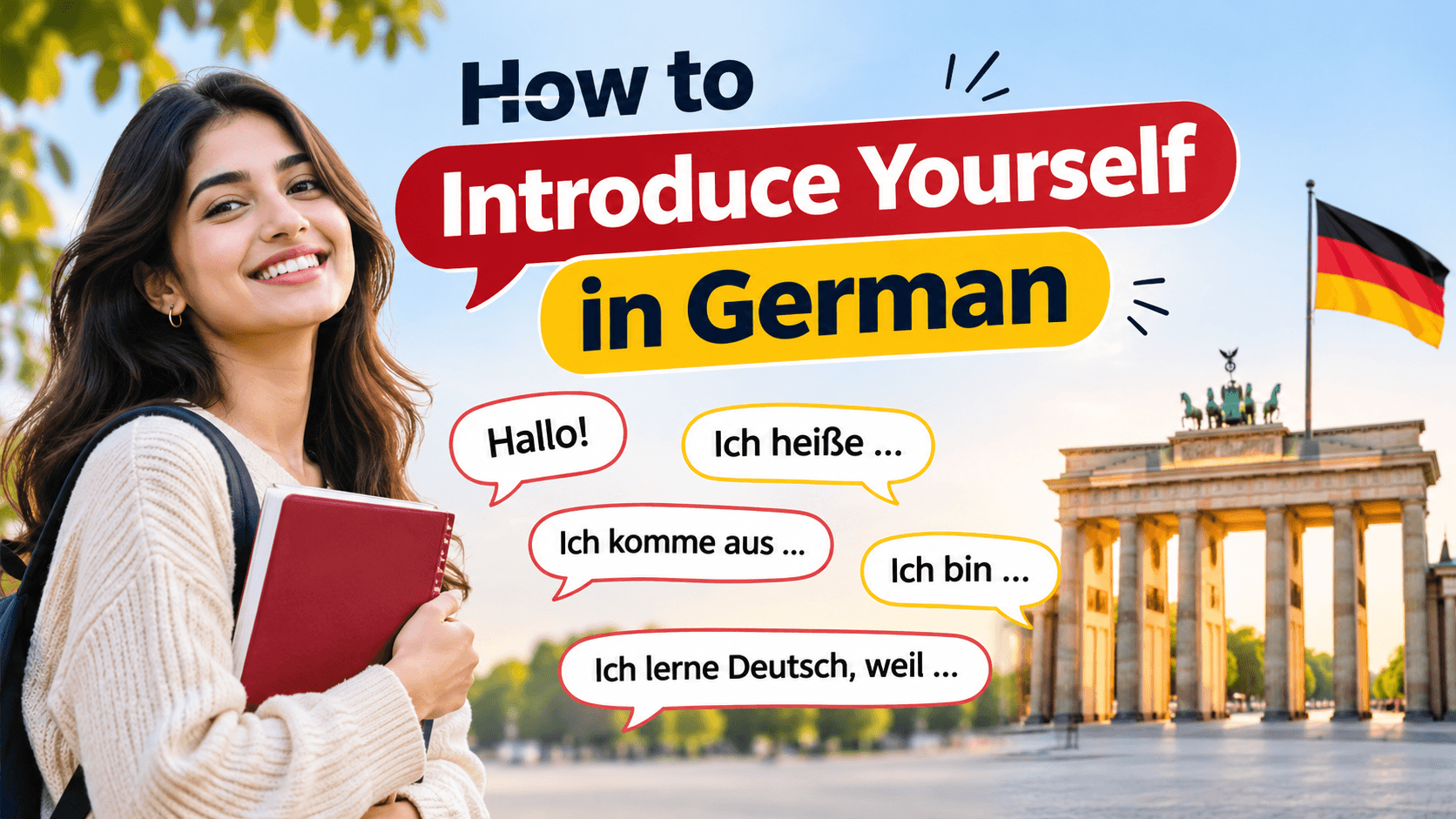
How to Introduce Yourself in German
Doitsu · 21 November 2026
Your first sentence in any new language is almost always the same: "Hello, my name is…" In German, that single moment opens the door to friendships, classrooms, job interviews and the A1 speaking exam.
The good news is that self introduction in German is one of the easiest topics for beginners. You only need a few patterns, a handful of verbs and some confidence. In this guide from Doitsu – The German Language Institute, you will learn how to introduce yourself in German step by step, with English translations, pronunciation help, ready-made examples for students and professionals, and a full FAQ section.
Why Self Introduction Matters
Introducing yourself is the foundation of German conversation for beginners. It is also a compulsory part of the Goethe A1 speaking test, where examiners expect you to say your name, country, age, profession and hobbies, and to answer simple questions.
Mastering this topic gives you three quick wins:
-
Confidence: you can start a conversation from day one.
-
Exam readiness: the same sentences appear in the A1 speaking module. See our guide to German A1 exam preparation in Delhi.
-
Real-life use: classes, workplaces, travel, and even Ausbildung interviews.
German Greetings and Introductions
Before you say your name, you greet the person. German greetings and introductions depend on the time of day and how formal the situation is.
|
German |
Pronunciation |
English |
|
Hallo! |
HAH-loh |
Hello! |
|
Hi! |
hy |
Hi! (very informal) |
|
Guten Morgen! |
GOO-ten MOR-gen |
Good morning! |
|
Guten Tag! |
GOO-ten tahk |
Good day / Hello |
|
Guten Abend! |
GOO-ten AH-bent |
Good evening! |
|
Gute Nacht! |
GOO-te nakht |
Good night! |
|
Tschüss! |
tchuess |
Bye! |
|
Auf Wiedersehen! |
owf VEE-der-zay-en |
Goodbye (formal) |
Basic German greetings also include Wie geht's? (How are you?) and the reply Gut, danke. Und dir? (Fine, thanks. And you?). Germans greet each other with a handshake in formal settings and often keep eye contact, which is considered polite.
How to Say "My Name Is" in German
There are three common ways to say "my name is" in German. All of them are correct and beginner-friendly.
|
German |
Pronunciation |
English |
|
Ich heiße Anil. |
ikh HY-suh |
I am called Anil. |
|
Mein Name ist Anil. |
mine NAH-muh ist |
My name is Anil. |
|
Ich bin Anil. |
ikh bin |
I am Anil. |
The most natural choice is Ich heiße… The verb heißen means "to be called", and it follows the regular pattern:
-
ich heiße
-
du heißt
-
er/sie heißt
-
wir/sie/Sie heißen
How do you ask someone's name?
-
Wie heißt du? (informal) means "What is your name?"
-
Wie heißen Sie? (formal) means "What is your name?"
-
Und wie heißt du? means "And what is your name?"
So, if you wondered about "Wie heißt du" meaning in English, it is simply "What are you called?", or "What's your name?"
After the name, say a polite phrase:
-
Freut mich! (Nice to meet you!)
-
Sehr erfreut. (Pleased to meet you, formal)
-
Angenehm. (Pleased to meet you, formal)
Mini dialogue:
A: Hallo! Ich heiße Priya. Und wie heißt du?
B: Hallo Priya! Ich heiße Rahul. Freut mich!
A: Freut mich auch!
Where Are You From? Age, City and Languages
After the name, most conversations move to origin, age and place of living. These German introduction sentences are essential.
Where are you from?
|
German |
English |
|
Woher kommst du? |
Where are you from? (informal) |
|
Woher kommen Sie? |
Where are you from? (formal) |
|
Ich komme aus Indien. |
I am from India. |
|
Ich komme aus Delhi. |
I come from Delhi. |
If you are wondering how to say "I am from India" in German, the answer is Ich komme aus Indien. The verb kommen means "to come", and aus means "from".
Where do you live?
-
Wo wohnst du? (Where do you live?)
-
Ich wohne in Delhi. (I live in Delhi.)
-
Ich wohne in Laxmi Nagar. (I live in Laxmi Nagar.)
How old are you?
-
Wie alt bist du? (How old are you?)
-
Ich bin zwanzig Jahre alt. (I am twenty years old.)
You may also drop Jahre alt in casual speech: Ich bin zwanzig.
Which languages do you speak?
-
Welche Sprachen sprichst du? (Which languages do you speak?)
-
Ich spreche Hindi, Englisch und ein bisschen Deutsch. (I speak Hindi, English and a little German.)
Learning numbers helps here, and so does knowing the calendar. If you want to talk about your birthday, read our guide on the days, months and seasons in German.
Talking About Your Job, Studies and Hobbies
Next, share what you do. This is where your introduction starts to sound personal.
Profession and studies
|
German |
English |
|
Ich bin Student / Studentin. |
I am a student (male / female). |
|
Ich bin Schüler / Schülerin. |
I am a school student. |
|
Ich arbeite als Ingenieur. |
I work as an engineer. |
|
Ich arbeite bei einer IT-Firma. |
I work at an IT company. |
|
Ich studiere Informatik. |
I study computer science. |
|
Was machst du beruflich? |
What do you do for a living? |
Note that German professions often have male and female forms: Lehrer / Lehrerin (teacher), Arzt / Ärztin (doctor), Ingenieur / Ingenieurin (engineer).
Hobbies
The easiest pattern is Ich + verb + gern, which means "I like to…"
-
Ich spiele gern Kricket. (I like playing cricket.)
-
Ich lese gern Bücher. (I like reading books.)
-
Ich höre gern Musik. (I like listening to music.)
-
Ich koche gern. (I like cooking.)
-
Mein Hobby ist Fotografieren. (My hobby is photography.)
Use gern after the verb, and you instantly sound more natural. For more everyday sentence patterns like these, explore our list of 100 daily-use German phrases for beginners.
How to Introduce Your Family in German
Family is a favourite topic in A1 exams, so how to introduce your family in German is worth practising.
|
German |
English |
|
die Familie |
family |
|
der Vater / die Mutter |
father / mother |
|
der Bruder / die Schwester |
brother / sister |
|
die Eltern |
parents |
|
der Großvater / die Großmutter |
grandfather / grandmother |
Useful sentences:
-
Ich habe eine kleine Familie. (I have a small family.)
-
Meine Familie hat vier Personen. (My family has four people.)
-
Mein Vater heißt Suresh und er ist Lehrer. (My father is called Suresh and he is a teacher.)
-
Meine Mutter heißt Anita und sie ist Hausfrau. (My mother is called Anita and she is a homemaker.)
-
Ich habe einen Bruder und eine Schwester. (I have one brother and one sister.)
Pay attention to the article after haben. Masculine nouns change to einen (einen Bruder), while feminine nouns stay eine (eine Schwester). If articles feel confusing, our post on German articles: der, die, das made simple will help.
Formal vs Informal: du or Sie?
German has two ways of saying "you":
-
du is for friends, family, classmates and children.
-
Sie (always capitalised) is for strangers, teachers, interviewers and officials.
When in doubt, choose Sie first. Germans will happily offer du once they feel comfortable.
Complete A1 Self Introduction Examples
Here are ready-to-use samples for self introduction in German for A1 level, each with an English translation. Read them aloud, then change the details to match your own life.
Example: Student Introduction
Hallo! Ich heiße Neha Sharma. Ich komme aus Indien, aus Delhi. Ich bin zwanzig Jahre alt. Ich bin Studentin. Ich lerne Deutsch bei Doitsu. Mein Hobby ist Lesen. Vielen Dank!
Hello! My name is Neha Sharma. I come from India, from Delhi. I am twenty years old. I am a student. I am learning German at Doitsu. My hobby is reading. Thank you very much!
Your Template
Copy this template and fill in the blanks:
Hallo! Ich heiße ___. Ich komme aus ___. Ich wohne in ___. Ich bin ___ Jahre alt. Ich bin ___ (Beruf). Ich spreche ___. Mein Hobby ist ___. Ich lerne Deutsch, weil ___. Freut mich!
How to Introduce Yourself in a German Job Interview
A German introduction speech for beginners is simple, but a job interview needs a more formal tone. Use Sie, speak clearly and focus on education, experience and motivation.
Opening lines:
-
Guten Tag, vielen Dank für die Einladung. (Good day, thank you for the invitation.)
-
Mein Name ist Amit Kumar, und ich freue mich, hier zu sein. (My name is Amit Kumar, and I am glad to be here.)
Sample answer to "Stellen Sie sich bitte vor" (Please introduce yourself):
Ich heiße Amit Kumar und komme aus Delhi in Indien. Ich habe Maschinenbau studiert und habe zwei Jahre Berufserfahrung. Ich spreche Englisch fließend und Deutsch auf Niveau B1. Ich bin motiviert, teamfähig und lerne gern Neues. Deshalb möchte ich gern bei Ihrem Unternehmen arbeiten.
My name is Amit Kumar and I come from Delhi in India. I studied mechanical engineering and have two years of work experience. I speak English fluently and German at B1 level. I am motivated, a team player and enjoy learning new things. That is why I would like to work at your company.
If you are planning to move to Germany for vocational training, read our guides on the German language level required for Ausbildung and the German language course for Ausbildung in Delhi.
Pronunciation Tips
Good pronunciation makes even simple sentences sound confident. German self introduction with pronunciation becomes easy once you know these rules:
-
ch after i/e sounds like a soft "kh". In ich, the sound is close to a hissing "ikh".
-
ß sounds like "ss". Ich heiße is "ikh HY-suh".
-
W sounds like V. Wie is "vee", wohne is "VOH-nuh".
-
Z sounds like "ts". Zwanzig is "TSVAHN-tsikh".
-
Ei sounds like "eye", ie sounds like "ee". Remember: heiße has "eye", Wie has "ee".
-
Ü and Ö need rounded lips. Tschüss and möchte are good examples to practise.
-
Verbs usually stress the first syllable. KOM-men, WOH-nen.
Record yourself, compare with native-speaker audio and repeat three times. Daily German conversation practice with a trainer or partner speeds this up.
Frequently Asked Questions (FAQs)
1. How do you introduce yourself in German?
Start with a greeting and your name: Hallo! Ich heiße Priya. Then add where you are from (Ich komme aus Indien), where you live (Ich wohne in Delhi), your age, job or studies, and a hobby. Finish with Freut mich!
2. How do you say "my name is" in German?
You can say Ich heiße…, Mein Name ist… or simply Ich bin… All three are correct. Ich heiße is the most common in daily conversation.
3. What does "Wie heißt du" mean in English?
Wie heißt du? means "What is your name?" It is the informal form. In formal situations, say Wie heißen Sie?
4. How do Germans greet each other?
Germans say Hallo or Hi among friends, Guten Morgen / Guten Tag / Guten Abend in neutral situations, and often shake hands in formal meetings. In southern Germany you may also hear Servus or Grüß Gott.
5. How do you say "Where are you from?" in German?
Say Woher kommst du? (informal) or Woher kommen Sie? (formal). The answer is Ich komme aus Indien.
6. How do you introduce yourself in German at A1 level?
At A1, you are expected to say your name, origin, residence, age, profession, languages and a hobby using simple sentences, and to answer basic questions such as Wie heißt du? Woher kommst du? Was machst du?
7. What are basic German greetings?
The most important ones are Hallo, Guten Morgen, Guten Tag, Guten Abend, Gute Nacht, Tschüss and Auf Wiedersehen, along with Wie geht's? and Danke.
8. How do you say "I am from India" in German?
Say Ich komme aus Indien. To be more specific, add the city: Ich komme aus Delhi.
9. How long does it take to learn German self introduction?
Most beginners can deliver a full A1 introduction in two to three weeks with daily practice. In a guided course, you will often practise it in your very first classes.
10. Where can I practise German speaking in Delhi?
Join a speaking-focused institute with small batches and live conversation practice. See our guide to the best German language institute in Delhi for what to look for.
Learn German with Doitsu in Delhi
Memorising sentences is a start, but fluency comes from speaking with an experienced trainer who corrects your pronunciation and builds your confidence. That is exactly what Doitsu – The German Language Institute offers.
Why students choose Doitsu:
-
Beginner-friendly classes that start with greetings and self introduction on Day 1
-
Speaking-first teaching with role plays, dialogues and regular German conversation practice
-
Small batches so every student speaks in every class
-
Goethe-aligned structure from A1 to C2 with mock tests and feedback
-
Guidance for study and Ausbildung aspirants heading to Germany
-
Easy location in Laxmi Nagar, Delhi, close to the metro
Explore our About page, find out why students pick Doitsu, or browse all German courses.
Where to start:
|
If you are... |
Start here |
|
A complete beginner |
|
|
Ready for everyday conversation |
|
|
Looking for classes nearby |
|
|
Comparing options |
|
|
Checking fees |
|
|
Preparing for the exam |
🚀 Ready to Say "Ich heiße…" with Confidence?
Stop worrying about speaking. Join a friendly batch, practise with real people and introduce yourself in German like a pro. Book your free demo class today.
👉 Enroll Now | 📞 Call Us | ✉️ Contact Us
Limited seats per batch. Message us today to reserve yours.
Contact Doitsu – The German Language Institute
Call Us +91 76783 94825
Email info@doitsugermanlanguageinstitute.com
Visit Us 3rd Floor, 2/81, Lalita Park, Laxmi Nagar, New Delhi, Delhi, 110092
Website: www.doitsugermanlanguageinstitute.com
Final Thoughts
Knowing how to introduce yourself in German is your first real step toward speaking the language. You now have greetings, name patterns, origin, age, job, hobby and family sentences, formal and informal forms, three complete A1 examples and a job interview sample. Practise a little every day, speak out loud, and soon your introduction will feel natural.
Take the next step with Doitsu, and turn your German language basics into confident conversation. Viel Erfolg! (Good luck!)